

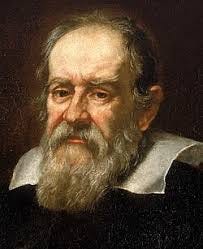
On this day in 1633, Galileo Galilei was hauled into court by the Roman Inquisition. He stood trial for heresy. The reasons why he was charged and tried illustrate not only his genius but also his courage in the face of belligerent ignorance and incompetent authority. His story reminds us of why he must be considered a Hall of Fame Gadfly.
A GENIUS BLOSSOMS
Of all the great Italian Renaissance thinkers and creators, Galileo Galilei ranks as high as any in terms of effect and influence, never mind that he was not canonized as a Ninja Turtle like some of his contemporaries. Born in the town of Pisa, he studied physics, philosophy, mathematics, astronomy, and medicine as well as technology in his formative years at university. Galileo would later come to be regarded as a seminal figure in establishing the modern foundations for science. His prodigious career turned out many brilliant achievements including making one of the first telescopes, spotting the moons of Jupiter, figuring out the Milky Way is composed of stars, and proving objects fall at a rate not related to their weight. Eventually, this progressive mentality put Galileo in peril over time.
The water began to boil in his life when he started to adopt the views of another astronomer named Nicolaus Copernicus. Specifically, Galileo championed the idea that the solar system revolved around the Sun instead of the Earth. This put him in direct opposition to the Catholic Church. At this time, remember, the Catholic Church essentially ruled Italy, so contradicting them could get him in trouble. That turned out to be the case—quite literally actually—and maybe more than he might have imagined before articulating and standing up for such a position.
IDEAS ON TRIAL
Yet, Galileo Galilei had some warning about the threat of gadfly ideas let loose in the mind and society. In 1616, Italian leaders apprehended him and entrusted him to the Roman Inquisition. If that makes you think of the Spanish Inquisition, then you are on the right track. They both were barbaric institutions built to torture and interrogate suspected criminals. Galileo entered the Roman Inquisition because he held the Copernican view of the universe. After some negotiating, he got off with a warning not to teach it anymore or espouse the notion in public. Unfortunately, they did not stop there. They also declared that his views were anti-science as well as anti-religion (apparently not understanding the inherent contradiction in such a statement) and then condescendingly described it as “foolish and absurd in philosophy.” Yikes! Bill Nye the Science Guy would be rolling in his laboratory.
Then, after the publishing of his controversial book on the same topic, Dialogue Concerning the Two Chief World Systems, the Inquisition decided they wanted to see him once more. Galileo faced the same charges as the 1616 case, namely, that he held and advocated the Copernican view that the Earth revolves around the Sun. Following a gamut of threats and interrogatories, the court found him guilty of holding heretical views. Galileo was put under house arrest for the rest of his life, and all of his books and ideas were banned from society.
A LEGACY FOR GALILEO
Normally, the conclusions about Galileo Galilei’s life begin with his specific accomplishments with regard to the scientific method, astronomical engineering and discovery, and theoretical physics. However, the discussion should not end there. His words and actions of defiance define his legacy with the imprimatur of a rebel. The wars he waged for science and truth against power built on top of ignorance and terror should define his legacy as much as anything he saw or built.
If you like this, follow me on Bluesky for more musings @chibillyob.bsky.social or on Substack Billy O’Brien