
Harriet Tubman $20 Bill Update (2026)
The definitive guide to the Harriet Tubman $20 Bill—history, redesign timeline, Treasury politics, public debate, and what the delay says about America.

Harriet Tubman $20 Bill: The Complete Story Behind America’s Most Controversial Currency Redesign
The Harriet Tubman $20 Bill refers to a proposed redesign of the U.S. twenty‑dollar note that would put abolitionist Harriet Tubman on the front, moving President Andrew Jackson to the back or removing him entirely. It was announced by the Obama administration in 2016, delayed under Donald Trump’s first term, nominally revived under Joe Biden, and—in 2026—appears stalled again at the Treasury Department.
Why Is Everyone Talking About the Harriet Tubman $20 Bill?
People are searching “Harriet Tubman $20 Bill” because a 2016 promise to put Harriet Tubman on the twenty‑dollar bill by 2020 still hasn’t been fulfilled. Recent reporting shows the $20 redesign is scheduled for 2030, yet Treasury officials now say there are “no current plans” to feature Tubman, keeping the controversy alive.
Why the topic is trending
The idea of Harriet Tubman on the $20 bill captured the public imagination in 2015–2016, when the Women on 20s campaign and then‑Treasury Secretary Jack Lew announced that Tubman would replace Andrew Jackson on the note. Tubman would have been the first Black woman on U.S. paper money and the first woman on a note in more than a century.
Interest surged again when Treasury Secretary Steven Mnuchin, serving under President Donald Trump’s first term, said in 2019 that the redesign would be delayed until at least 2028, citing a priority on anti‑counterfeiting security upgrades. The announcement sparked outrage from advocates who saw the delay as a political decision cloaked in technical language.
Under President Joe Biden, the White House said in early 2021 that the Treasury Department, now led by Janet Yellen, would “take steps to resume” efforts to put Harriet Tubman on the front of the new $20 notes. Internal documents and an Inspector General report, however, showed that the formal banknote development schedule still placed the redesigned $20 in 2030, after new $10 and $50 notes.
By 2026, the story took another turn: Treasury Secretary Scott Bessent stated that “there are no current plans” to feature Harriet Tubman on the $20 bill, even as the agency moves ahead with a broader “Catalyst” series redesign and plans to add Donald Trump’s portrait to a new $250 denomination. That disconnect between public promises and internal timelines is a key reason the Harriet Tubman twenty‑dollar bill remains headline news.
Who Was Harriet Tubman?
Harriet Tubman (c. 1822–1913) was born enslaved in Maryland, escaped to freedom, then risked her life repeatedly guiding others north on the Underground Railroad. During the Civil War, she served the Union as a scout, spy, and nurse and later campaigned for women’s suffrage, becoming one of the most influential freedom fighters in American history.
Early life in slavery
According to the National Park Service and the National Archives, Harriet Tubman was born Araminta “Minty” Ross around March 1822 in Dorchester County, Maryland, to enslaved parents Ben and Harriet (Rit) Ross. As a child she was hired out to other households, where she suffered brutal treatment and lifelong physical injury after being struck in the head by a heavy weight hurled by an overseer.
Historical records note that Tubman changed her name from Araminta to Harriet around 1844, after marrying John Tubman, a free Black man. When her enslaver Edward Brodess died in 1849 and she feared sale farther South, she escaped alone, traveling at night along networks of Black and white antislavery allies toward Philadelphia.
Escape and the Underground Railroad
Treasury documents and museum archives point out that Tubman did not stop at securing her own freedom. Over roughly a decade, she returned to Maryland about 13 times, personally leading some 70 enslaved people—including siblings and parents—to freedom and guiding at least 70 more through detailed instructions.
Because of her daring raids, abolitionist William Lloyd Garrison and others called her “Moses,” a nickname that appears repeatedly in contemporary accounts and later biographies. Tubman carefully studied the stars, local terrain, and secret communication networks among free and enslaved African Americans, skills she had developed while working in fields, forests, and on Chesapeake Bay wharves.
Civil War service
During the Civil War, Tubman shifted from clandestine rescuer to official agent of the Union Army. National Park Service records show that she served as a nurse, cook, scout, and spy in Union camps, particularly in South Carolina, where she treated Black soldiers and civilians.
Her most famous wartime mission, the Combahee River Raid of June 1863, saw Tubman collaborate with Colonel James Montgomery and Black troops of the 2nd South Carolina Infantry to free more than 700 enslaved people, many of whom later joined the Union forces. The raid damaged Confederate plantations and strengthened the Union both militarily and morally, underscoring Tubman’s role in the broader struggle that culminated in Abraham Lincoln’s Emancipation Proclamation and, eventually, the Thirteenth Amendment abolishing slavery.
Women’s suffrage and later years
After the war, Tubman settled in Auburn, New York, on land she had purchased from Secretary of State William Seward and later used to establish the Harriet Tubman Home for the Aged. She became an outspoken advocate for women’s suffrage, working closely with leaders such as Susan B. Anthony, Lucretia Mott, and Martha Coffin Wright and speaking at suffrage conventions in New York and beyond.
Library of Congress materials and suffrage archives show that Tubman saw women’s voting rights as the next stage of her lifelong fight for freedom and equality. She died in Auburn on March 10, 1913, and was buried with military honors at Fort Hill Cemetery, cementing her status as a national hero remembered today by institutions ranging from the National Park Service to the National Museum of African American History and Culture.
Why Was Harriet Tubman Chosen to Replace Andrew Jackson?
Harriet Tubman was chosen to replace Andrew Jackson on the $20 bill after the grassroots Women on 20s campaign held an online vote and Tubman emerged as the top public choice. In 2016, Treasury Secretary Jack Lew announced that Tubman would appear on the front of the redesigned twenty‑dollar note, reflecting a shift toward honoring women and civil rights history on U.S. currency.
Women on 20s and public voting
Women on 20s, a nonprofit campaign, launched an online vote in 2015 asking Americans which woman should appear on the twenty‑dollar bill. The group’s founders argued that Andrew Jackson—known for the Indian Removal Act and his role in the Trail of Tears—was a problematic symbol and that 2020, the centennial of women’s suffrage, was the right moment to honor a woman on the note.
Over 600,000 people participated, narrowing a list of 15 candidates that included Harriet Tubman, Rosa Parks, Eleanor Roosevelt, and Wilma Mankiller. Harriet Tubman won the final round with more than 118,000 votes, giving the campaign clear public backing for putting Harriet Tubman on the $20 bill.
The Treasury decision
Jack Lew initially proposed putting a woman on the $10 bill, replacing Alexander Hamilton, but that plan changed amid public support for Hamilton following the hit musical of the same name. In April 2016, Lew announced instead that Harriet Tubman would appear on the front of the twenty‑dollar note, with Andrew Jackson’s portrait moved to the back alongside the White House.
Treasury statements from that period framed the decision as both symbolic and practical: symbolic in honoring an abolitionist and Underground Railroad conductor whose story fits alongside the Emancipation Proclamation and Reconstruction, practical in that the $20 was already slated for redesign within a new security‑driven schedule.
Symbolic importance
Placing Harriet Tubman on the twenty‑dollar bill would represent several firsts: the first Black woman on U.S. paper money, the first woman on a widely‑circulated note in more than a century, and a move away from an exclusive focus on presidents as “faces” of American currency.
For many historians and activists, including those at the Smithsonian Institution and NMAAHC, Tubman’s image would connect the daily transaction of money with stories of resistance to slavery, the Underground Railroad, women’s suffrage, and the unfinished struggle for civil rights. Supporters also noted that Tubman’s life intersected with other iconic figures such as Frederick Douglass, Sojourner Truth, and Susan B. Anthony, making her a bridge between abolition and women’s rights.
Harriet Tubman $20 Bill Timeline (1822–Present)
The Harriet Tubman $20 Bill timeline spans Harriet Tubman’s birth in 1822, her Underground Railroad work and Civil War service, the Women on 20s campaign in 2015, Jack Lew’s 2016 redesign announcement, delays under Steven Mnuchin, a partial revival under Janet Yellen, and recent signals from Treasury Secretary Scott Bessent that Tubman may not appear on the 2030 $20 redesign after all.
Chronological timeline with context
1822–1849 – Tubman’s early life and escape
Harriet Tubman is born enslaved in Maryland around 1822, experiences severe abuse, and escapes in 1849 after the death of her enslaver, heading north via Underground Railroad routes.1850s–1863 – Underground Railroad and Civil War
Tubman makes some 13 trips back to Maryland, freeing around 70 people directly and guiding dozens more, then serves as a Civil War scout, spy, and nurse, helping lead the 1863 Combahee River Raid.1865–1913 – Suffrage activism and legacy
After the war, Tubman settles in Auburn, New York, promotes women’s suffrage, works with Susan B. Anthony, and runs the Harriet Tubman Home for the Aged until her death in 1913.1928 – Andrew Jackson on the $20
Andrew Jackson’s portrait appears on the front of the U.S. twenty‑dollar bill for the first time, with the White House on the back, cementing his presence on American currency for generations.1996–2003 – Modern $20 security redesigns
The Series 1996 and 2003 twenty‑dollar notes introduce larger portraits, color‑shifting ink, security threads, watermarks, microprinting, and raised printing to combat counterfeiting. These features come from work by the Treasury Department, Bureau of Engraving and Printing (BEP), and Federal Reserve.2015 – Women on 20s vote
Women on 20s runs its online vote; Harriet Tubman wins as the public’s choice to replace Jackson on the $20 bill, and the group petitions the White House and Treasury.April 2016 – Jack Lew’s announcement
Treasury Secretary Jack Lew announces that Harriet Tubman will appear on the front of the redesigned $20 note, with Jackson moved to the back, and suggests note designs could be revealed by 2020.2017–2019 – Mnuchin delays redesign
Under Donald Trump’s first term, Treasury Secretary Steven Mnuchin says he will not commit to the Tubman redesign and announces that the $10 and $50 notes will be redesigned first for security reasons. In 2019, Mnuchin states the new $20 will not be issued until 2028 and that designs will not be unveiled until 2026.2019–2020 – Inspector General investigation and ACD report
NPR reports that the Treasury Inspector General opens an inquiry into the delay and whether political considerations affected the process. An Inspector General report later notes that Lew’s 2016 timeline was announced outside formal banknote governance and confirms a long‑standing plan for the $20 note to be redesigned around 2030.January 2021 – Biden administration “resumes efforts”
White House Press Secretary Jen Psaki says under President Joe Biden that the Treasury Department is taking steps to resume efforts to put Harriet Tubman on the front of the new $20 notes.2023–2025 – Legislative pushes for Tubman note
Senator Jeanne Shaheen introduces a bill requiring all $20 Federal Reserve notes printed after December 31, 2030 to bear Tubman’s likeness, allowing only a two‑year delay for technical issues. A separate House bill, the “Woman on the Twenty Act,” seeks to require that no $20 note printed after December 31, 2026 be issued without Tubman on the front and that preliminary designs be released by late 2024.2025 – “Catalyst” series schedule and 2030 target
A 2025 report on the BEP’s Catalyst series confirms a production schedule: $10 note in 2026, $50 in 2028, $20 in 2030, followed by other denominations later in the decade.2026 – Scott Bessent’s “no current plans” statement
In 2026, Treasury Secretary Scott Bessent tells reporters that there are “no current plans” to place Harriet Tubman on the $20 bill, even as the broader redesign program advances and the department prepares a new $250 denomination featuring Donald Trump. That position suggests the Tubman note is no longer on the active redesign agenda, despite earlier public commitments.
What Would the Harriet Tubman $20 Bill Look Like?
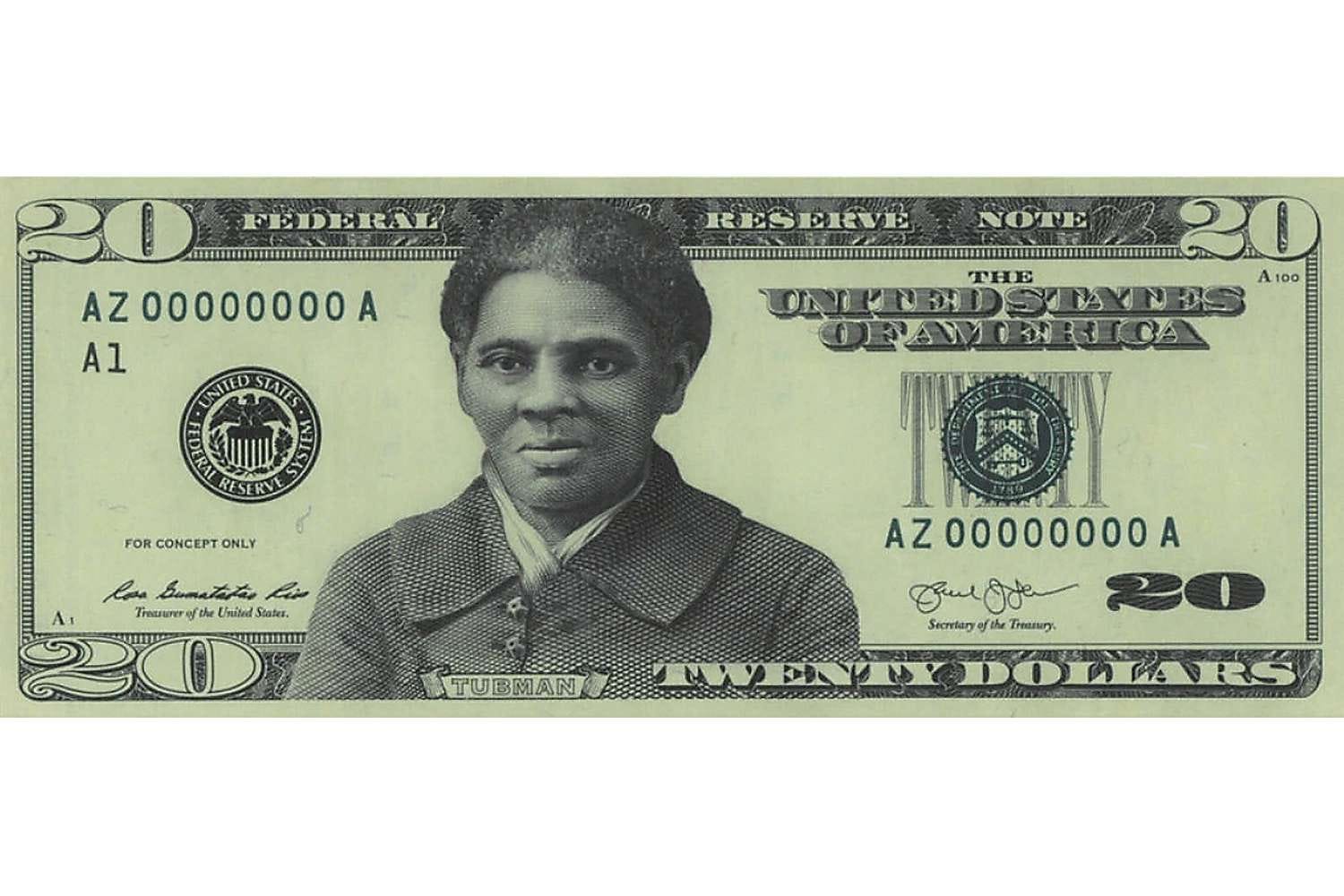
Mock‑ups of the Harriet Tubman $20 Bill show a front portrait of Tubman, often based on mid‑life photographs, with updated security features like color‑shifting ink, embedded security threads, watermarks, and microprinting. The proposed design would likely keep the green‑and‑tan palette and modern anti‑counterfeiting technology while replacing Andrew Jackson’s central image with Tubman.
Biden Administration Wants Harriet Tubman on $20 Bill
Portrait and proposed design
The Treasury Department has never released an official final design for the Harriet Tubman $20 Bill, but unofficial mock‑ups circulated by news outlets and advocates draw from mid‑19th‑century portraits held by the Library of Congress and museum collections. These images show Tubman wearing a headscarf and plain dress, conveying the steady resolve that defined her work on the Underground Railroad.
Jack Lew’s 2016 announcement indicated that Tubman’s portrait would appear on the front of the note, while Andrew Jackson would either be moved to the back or reduced to a secondary image alongside the White House. Women on 20s and other advocates pressed for a design that positioned Tubman as the central figure, not merely an add‑on to existing iconography.
Security features and anti‑counterfeiting technology
Treasury documents and the $20 bill’s current specifications show that modern notes use a suite of security features: security fibers in the paper, an embedded security thread, watermarks, color‑shifting ink on numerals, microprinting along borders, raised printing, and the EURion constellation pattern that helps machine readers detect currency.
The BEP’s Catalyst series development process emphasizes integrating new security features into designs from the start, so any Harriet Tubman twenty‑dollar bill would be engineered around advanced anti‑counterfeiting technology. That might include improved security threads that glow under specific wavelengths of light, more complex color‑shifting inks, and enhanced microprinting that becomes harder to reproduce digitally.
Comparison with the current $20 bill
Today’s $20 note features Andrew Jackson’s portrait slightly off‑center on the front and a view of the White House on the back, with green and peach colors and the security features introduced in the late 1990s and early 2000s. Tubman’s image would likely occupy similar visual real estate, though advocates have argued for more contextual imagery—such as subtle references to the Underground Railroad or the Combahee River Raid—in the background.
For editors at Gadfly City, a useful image placement here would be a side‑by‑side comparison of the current Andrew Jackson note and a Tubman mock‑up, with alt text such as: “Current Andrew Jackson $20 bill next to proposed Harriet Tubman $20 Bill design featuring Tubman’s portrait and updated security features.”
Why Is Andrew Jackson Still on the $20 Bill?
Andrew Jackson remains on the $20 bill because the formal currency redesign schedule prioritizes security upgrades and places the twenty‑dollar note’s next redesign around 2030, while political changes at the Treasury have stalled the Tubman plan. Jackson’s controversial legacy—including the Indian Removal Act and the Trail of Tears—has not yet overcome institutional inertia in currency design.
Jackson’s presidency and the Indian Removal Act
Andrew Jackson, the seventh U.S. president, served from 1829 to 1837 and is known both for expanding white male democracy and for championing Indian removal policies that led to the forced displacement and mass death of Native peoples. The Indian Removal Act of 1830 paved the way for the Trail of Tears, in which thousands of Cherokee and other Indigenous people were marched west under brutal conditions.
Historians and Native advocates have long argued that honoring Jackson on paper money implicitly celebrates policies that treated Indigenous communities as obstacles to land speculation and white settlement. That critique intensified as movements for racial justice and Indigenous rights drew parallels between Jackson’s era and modern struggles over land, policing, and citizenship.
Why opinions differ
Supporters of keeping Jackson on the $20 bill often argue that currency portraits should reflect long‑standing presidential figures and that revising notes for political reasons sets a troubling precedent. They point to Jackson’s role in shaping early American politics and his image as a symbol of populist resistance to elite power, even as they acknowledge his policies toward Native nations.
Critics counter that U.S. currency has always been a political statement, citing previous changes that added or removed presidents and allegorical figures and that modern notes should better reflect the diversity of people who fought for freedom, from Harriet Tubman to Rosa Parks, Maya Angelou, and Sacagawea. The Harriet Tubman redesign thus sits at the intersection of debates about history, representation, and what it means to be honored on American currency.
How the U.S. Treasury Redesigns Currency
U.S. currency redesign is led by the Treasury Department, working through the Bureau of Engraving and Printing and the Federal Reserve, with oversight from the Advanced Counterfeit Deterrence Steering Committee. The process involves years of research, technology development, security testing, and design integration before a new note is revealed only months before issuance.
Treasury, BEP, and the Federal Reserve
The U.S. Treasury is responsible for overall currency policy, while the Bureau of Engraving and Printing (BEP) designs and prints paper notes and the Federal Reserve issues them into circulation. BEP’s strategic plans highlight its dual mission: making secure, high‑quality banknotes and innovating anti‑counterfeiting technology as counterfeiters adopt advanced printing and digital tools.
The Federal Reserve, working with the Secret Service and other agencies, monitors counterfeiting trends and usage patterns across denominations to determine which notes most urgently need redesign. Its decisions influence the sequence of the Catalyst series, which treats the $5, $10, $20, $50, and $100 notes as a “family” to be redesigned collectively with shared architecture.
Banknote security testing and approval
According to Inspector General reports and BEP documentation, banknote development follows a structured process: a Banknote Development Process to integrate new security features and design concepts, and a Technology Development Process to mature specific technologies before they are embedded in notes.
Security features—from microprinting and security threads to color‑shifting ink and watermarks—are tested for durability, machine readability, and resistance to known counterfeiting techniques. Only after extensive trials and coordination with cash‑handling industries, like ATMs and vending equipment, does Treasury approve a final design.
Why redesign takes a decade
BEP officials have stated that redesigning a note can take close to a decade from concept to circulation, particularly for heavily used denominations like the $20 bill. The schedule for the Catalyst series shows production starting with the $10 in 2026, the $50 in 2028, and the $20 in 2030, reflecting both security priorities and the need to phase in new technology.
Designs are typically revealed only about six months before issuance, partly to prevent counterfeiters from having years to prepare and partly to allow for public education on new security features. That timing helps explain why, despite multiple public statements about Harriet Tubman on the $20, no official Tubman note artwork has appeared from Treasury or BEP.
Why Has the Harriet Tubman $20 Bill Been Delayed?
The Harriet Tubman $20 Bill has been delayed because the formal security‑driven redesign schedule puts the twenty‑dollar note in 2030, while successive administrations have shifted priorities, leaving Tubman’s portrait in limbo. Treasury officials cite anti‑counterfeiting needs, but investigations and recent statements suggest political and administrative changes have also shaped the delays.
Administrative changes and shifting priorities
Under Barack Obama, Jack Lew publicly embraced the Tubman redesign and suggested concept art might be unveiled by 2020. Under Donald Trump’s first term, Steven Mnuchin emphasized security concerns, refused to commit to Tubman, and repeatedly pushed the timetable back to align with the pre‑existing redesign sequence.
During Joe Biden’s administration, the White House signaled that efforts would be “resumed,” but internal Treasury schedules still placed the $20 note’s next major redesign around 2030, after the $10 and $50 notes. As of 2026, under Donald Trump’s second term and Scott Bessent’s leadership at Treasury, officials now say there are no current plans to feature Tubman, effectively freezing the Harriet Tubman redesign.
Security priorities and ACD guidance
The Advanced Counterfeit Deterrence Steering Committee (ACD) guides which denominations are redesigned first based on counterfeiting risk. A 2025 report notes that since 2013, the $10 note has typically led redesign sequences, with occasional shifts between the $5 and $50 as threats evolve.
The Inspector General’s review concluded that Lew’s 2016 public promise to reveal designs in 2020 did not reflect the internal governance structure and that the ACD never intended the Catalyst series designs to appear that early. In this view, the Tubman timeline was always optimistic and disconnected from the technical reality of banknote development.
Treasury statements and investigations
Mnuchin told Congress that the delay was “nonpolitical” and driven by security issues, but legislators like Senator Chuck Schumer requested investigations into whether the redesign had been slowed for political reasons. The Inspector General’s review folded the Tubman question into a broader look at BEP project management, interviewing officials from Treasury, BEP, the Federal Reserve, the Secret Service, and the White House.
Recent coverage quoting Scott Bessent’s “no current plans” remark further suggests that the Harriet Tubman twenty‑dollar bill is now a discretionary choice rather than a guaranteed outcome of the Catalyst schedule. In other words, the delay is both technical and political, with different administrations interpreting the redesign’s symbolism and timing in very different ways.
Public Opinion
Public opinion on the Harriet Tubman $20 Bill is broadly favorable to putting Harriet Tubman on the twenty‑dollar note but divided over removing Andrew Jackson and over whether currency should be used to make political statements. Polls, campaigns, and legislative efforts show strong support for Tubman, while some critics worry about “politicizing” money.
Support for Harriet Tubman on the $20
The Women on 20s vote, with over 600,000 participants, showed strong grassroots support for Harriet Tubman on the $20 bill, beating out other icons like Rosa Parks and Eleanor Roosevelt. Lawmakers from both parties have introduced bills that would mandate a Tubman note by specific dates, reflecting that public pressure has reached Congress.
Cultural commentators at outlets like The New Yorker and public historians at the Smithsonian argue that featuring Tubman would highlight stories of resistance and make everyday transactions a reminder of America’s struggle against slavery and racism. For many Americans, seeing Harriet Tubman on the twenty‑dollar bill would validate the importance of abolitionists and Black women in national memory.
Concerns and criticism
Critics worry that replacing Andrew Jackson could trigger partisan disputes over which historical figures “deserve” to be on money and that frequent changes might undermine the perceived neutrality of currency. Some conservative commentators, including Donald Trump during his first presidential campaign, called the Tubman proposal “pure political correctness” and suggested honoring her on a different denomination or leaving Jackson untouched.
Others question whether symbolically changing currency without broader structural reforms—such as addressing racial wealth gaps, banking discrimination, or unequal access to credit—risks turning Harriet Tubman into a decorative figure rather than honoring her radical challenge to slavery and inequality. Nevertheless, these critics often still recognize Tubman’s heroism; they disagree mainly on how and where she should be commemorated.
Myths vs. Facts
The Harriet Tubman $20 Bill has generated several myths, including the belief that Tubman is already on the twenty‑dollar bill and that the redesign was canceled outright. In fact, Andrew Jackson remains on the note, the formal redesign is planned for 2030, and whether Tubman will appear depends on future Treasury decisions and legislation.
Common misconceptions
Myth about the Harriet Tubman $20 Bill: Harriet Tubman is already on the $20 bill.
Fact: Andrew Jackson still appears on the current twenty‑dollar bill; no Harriet Tubman note has entered circulation.
Myth about the Harriet Tubman $20 Bill: The redesign was guaranteed for 2020 and then canceled.
Fact: Jack Lew proposed unveiling designs by 2020, but internal governance always placed the $20 redesign later; the plan was delayed, not formally canceled, then effectively sidelined.
Myth about the Harriet Tubman $20 Bill: Security features were invented just to block Tubman.
Fact: Anti‑counterfeiting priorities long pre‑date the Tubman debate; Catalyst series security upgrades would have been necessary regardless of who appeared on the $20.
Myth about the Harriet Tubman $20 Bill: Congress has no role in currency portraits.
Fact: While Treasury leads design choices, Congress can pass laws directing portrait changes, as proposed in the Woman on the Twenty Act and Senator Shaheen’s bill.
Myth about the Harriet Tubman $20 Bill: Putting Harriet Tubman on the $20 bill erases Andrew Jackson from history.
Fact: Critics of Jackson’s policies argue that textbooks and museums still document his legacy; removing him from the note changes symbolic representation, not historical records.
Myth about the Harriet Tubman $20 Bill: Only presidents can appear on U.S. money.
Fact: U.S. coins have featured women like Susan B. Anthony, Sacagawea, and Maya Angelou, and historical figures on paper money have included non‑presidents in the past.
Myth about the Harriet Tubman $20 Bill: The redesign would be simple and quick.
Fact: BEP and Treasury say it takes close to a decade to research, test, and finalize a new banknote, especially popular denominations like the $20.
How This Redesign Compares With Other U.S. Currency Changes
The Harriet Tubman $20 Bill proposal fits into a long history of U.S. currency redesigns driven by both security and symbolism, from anti‑counterfeiting overhauls in the 1990s to new portraits and themes on coins like the Susan B. Anthony dollar, Sacagawea dollar, and American Women Quarters.
Previous note redesigns
The twentieth century saw multiple redesigns of U.S. paper money, including shifts in portraits, sizes, and colors for notes such as the $10, $20, and $100. The Series 1996 and 2004 redesigns, for example, added color backgrounds, larger off‑center portraits, and advanced security features that responded to digital printing and high‑resolution scanning.
These changes often sparked commentary but rarely centered on whose face appeared; the Harriet Tubman twenty‑dollar bill is unusual because the portrait itself became the main public issue, rather than the security features around it.
Coins and symbolic redesigns
Coins have long served as platforms for symbolic change. The Susan B. Anthony dollar, issued from 1979 to 1981 and again in 1999, was the first circulating U.S. coin to feature a non‑mythical woman, honoring a leader of the women’s suffrage movement. The Sacagawea dollar followed in 2000 with a golden color and a portrait of Sacagawea carrying her child, based on a modern Shoshone‑Bannock woman Randy’L He‑dow Teton.
More recently, the American Women Quarters program introduced designs featuring Maya Angelou, Sally Ride, Wilma Mankiller, and other women, marking a deliberate effort by the U.S. Mint to diversify numismatic imagery. Seen in this context, Harriet Tubman on the $20 bill would extend a broader trend of lifting women’s stories onto everyday currency.
Women Featured on U.S. Coins and Proposed U.S. Currency
Women already appear on U.S. coins—including Susan B. Anthony on the dollar, Sacagawea on the Native American dollar, and Maya Angelou on a quarter—while Harriet Tubman remains a proposed figure for the $20 bill. These designs reflect growing recognition of women’s roles in American history and suffrage movements.
Existing coins with women
The Susan B. Anthony dollar honored the famed suffrage leader and was the first circulating coin to feature a real woman’s portrait on the obverse. The Sacagawea “golden dollar” followed, showing Sacagawea with her infant son, commemorating her crucial role in guiding the Lewis and Clark expedition.
In 2022, the U.S. Mint debuted the Maya Angelou quarter as the first coin in the American Women Quarters program, making Angelou the first Black woman on a U.S. quarter. Additional quarters in this series celebrate women from Native American leaders to astronauts and civil rights activists.
Proposed notes and broader representation
Beyond Harriet Tubman, advocates have floated figures such as Rosa Parks, Sojourner Truth, Susan B. Anthony, and Eleanor Roosevelt for future notes and coins, arguing that American currency should better reflect the nation’s diversity and social movements. Legislative ideas range from rotating portraits to thematic series, similar to the State Quarters or American Women Quarters programs.
For Gadfly City’s editors, an internal link to a piece like “Women on U.S. Currency” would naturally complement this section, as would links to feature stories about Sacagawea, Susan B. Anthony, and Maya Angelou.
Frequently Asked Questions
These FAQ answers on the Harriet Tubman $20 Bill summarize the redesign timeline, political debate, and technical process behind putting Harriet Tubman on the twenty‑dollar note. Each response is concise—under 75 words—and suitable for FAQPage schema to help search engines surface authoritative information about the Harriet Tubman redesign.
Is Harriet Tubman on the $20 bill yet?
No. Andrew Jackson still appears on the current $20 bill, and no Harriet Tubman twenty‑dollar bill has entered circulation.
When was the Harriet Tubman $20 Bill first announced?
Treasury Secretary Jack Lew announced in April 2016 that Harriet Tubman would appear on the front of the redesigned $20 note, moving Andrew Jackson to the back.
Why did the Harriet Tubman $20 Bill get delayed?
Treasury officials cited security priorities and a long‑standing redesign schedule that puts the $20 note’s next overhaul around 2030, while political changes also shifted focus away from the Tubman plan.
Who decides whose face goes on U.S. paper money?
The Treasury Department, through the Secretary of the Treasury, makes final decisions on portraits, with input from the BEP, Federal Reserve, and advisory bodies, and Congress can direct changes through legislation.
Will Harriet Tubman definitely be on the future $20 bill?
As of 2026, Treasury Secretary Scott Bessent says there are “no current plans” to put Harriet Tubman on the $20, meaning her appearance depends on future policy and laws.
What security features would be on a Harriet Tubman $20 Bill?
Any future Harriet Tubman twenty‑dollar bill would include modern security features such as color‑shifting ink, security threads, watermarks, microprinting, and raised printing like current high‑denomination notes.
How does the Harriet Tubman redesign relate to women’s suffrage?
The original goal was to introduce the Harriet Tubman $20 Bill around 2020, the centennial of the Nineteenth Amendment, connecting Tubman’s activism to women’s suffrage history.
Did Donald Trump oppose the Harriet Tubman $20 Bill?
During his first campaign, Donald Trump criticized replacing Jackson with Tubman as “political correctness,” and his administration’s Treasury delayed the redesign until at least 2028.
What role did Joe Biden’s administration play in the redesign?
Under Joe Biden, the White House said it would “resume efforts” to put Harriet Tubman on the $20, but internal schedules still targeted 2030 for the $20 redesign and did not guarantee Tubman.
What is the Woman on the Twenty Act?
A House bill introduced in the 118th Congress that would require all $20 notes printed after December 31, 2026 to feature Harriet Tubman and mandate a preliminary design by December 31, 2024.
How does the Harriet Tubman $20 Bill compare to women on coins?
Unlike coins that already feature women—like Susan B. Anthony, Sacagawea, and Maya Angelou—the Harriet Tubman $20 Bill remains proposed but unrealized, highlighting slower change on paper notes.
What is the Underground Railroad’s connection to the $20 redesign?
Harriet Tubman’s work on the Underground Railroad, guiding people from slavery to freedom, is central to why advocates want her on the $20 bill as a symbol of resistance and liberation.
What the Harriet Tubman $20 Bill Says About America Today
The unresolved fate of the Harriet Tubman $20 Bill reveals how American currency sits at the crossroads of history, politics, and technology. It shows a nation wrestling with how to represent abolition, Indigenous dispossession, and women’s rights on its money while balancing anti‑counterfeiting priorities and partisan disagreements.
Currency as a mirror of history
Treasury documents, museum archives, and suffrage records all point to Harriet Tubman as a figure whose life touched nearly every major story in nineteenth‑century American history: slavery, the Underground Railroad, the Civil War, emancipation, and women’s suffrage. Placing her on the twenty‑dollar bill would signal that those struggles are central to the national narrative, not footnotes.
At the same time, keeping Andrew Jackson on the $20 highlights enduring ambivalence about confronting the Indian Removal Act, the Trail of Tears, and a legacy built on land acquisition at the expense of Native nations. The Harriet Tubman redesign thus forces Americans to weigh which stories they want in their wallets: conquest and expansion, or resistance and liberation.
Technology, power, and representation
The Harriet Tubman $20 Bill debate also shows how technical systems—like banknote security schedules and the ACD’s threat assessments—can either support or stall symbolic change. Anti‑counterfeiting priorities are real and serious, yet the same processes can be invoked to delay portrait shifts, illustrating how bureaucratic structures intersect with political choices.
For editors at Gadfly City, internal links to explainer pieces such as “History of the U.S. $20 Bill,” “How U.S. Currency Is Designed,” “Harriet Tubman and the Underground Railroad,” “Andrew Jackson’s Legacy,” “Bureau of Engraving and Printing Explained,” and “U.S. Currency Security Features” would help readers follow those threads more deeply.
The unfinished story of the Harriet Tubman $20 Bill
Right now, the Harriet Tubman $20 Bill is less a piece of paper than a contested symbol of who America chooses to honor and how quickly institutions adapt to changing understandings of history. The fact that Harriet Tubman is celebrated in national parks, museums, and suffrage archives, yet not on the twenty‑dollar bill, underscores the gap between rhetorical recognition and structural change.
Whether future administrations and Congress ultimately put Harriet Tubman on the $20 or leave Jackson in place, the debate itself has taught millions of people to ask new questions about their money: whose stories are missing, whose are centered, and what it would mean—for abolitionists, for Indigenous communities, for women’s rights advocates—if every transaction carried the face of someone who fought for freedom rather than for exclusion. That, more than anything, is why the Harriet Tubman $20 Bill continues to matter.